Best AAC Devices for Children with Speech Difficulties
Our North Brisbane Speech Pathologists are talking AAC this October for AAC Awareness Month.
Lots of parents ask us the same question: “What is the best AAC device for my child?”
It’s a great question. The answer might surprise you.
The best set-up is usually not one device. It’s a mix of tools and ways to talk. We call this multimodal communication. “Multimodal” just means “more than one way”.
What does AAC mean?
A = Augmentative (extra ways to help speech)
A = Alternative (other ways to talk instead of speech)
C = Communication
AAC means any way of talking that is not just speech. It helps people of all abilities have a voice.
AAC helps your child:
- make choices about their day
- join in at home, at school and out in the community
- build friendships and enjoy life
Research shows that children who use AAC well feel better and have a better quality of life.
Why more than one way to talk?
Think about how you talk. You use words. You also point, nod, smile, shrug, text and send emojis. You pick the way that suits the moment & the message you want to tell.
It’s important to have different ways to communicate, here’s some reasons why:
- Batteries go flat. Devices break or get recalled and paper gets wet.
- Some places are hard to take a device. E.g. The pool, trampoline, car.
- Some messages are quick. A point, gesture or a sign is faster than typing.
- Confidence grows with successful messages. The more ways your child has to share a message, the more they will say.
So we teach lots of ways at once. Low tech and high tech work together and one does not replace the other.
The ways your child can communicate
1. Speech
What it looks like: Your child says “more”, “mum”, or part of a word like “ba” for ball.
A speech pathologist can help by: working on clear speech sounds, and teaching the family to listen for and respond to your child’s words, even if they are hard to understand.
Good to know: AAC does not stop children talking. Research shows it often helps speech grow.
2. Body language and facial expressions
What it looks like: Your child pushes a plate away. They smile at a favourite song. They look at the door when they want to go outside.
A speech pathologist can help by: teaching you to notice these messages, understanding what they mean, and shaping them into a more consistent format if possible (e.g. a visual)
An OT can help by: looking at how your child is using their motor skills. Motor skills involve turning their head, looking around and showing you what they want.
3. Gesture and pointing
What it looks like: Waving bye. Pointing at the biscuit tin. Holding up arms for a cuddle.
A speech pathologist can help by: building up your child’s gestures during play, and adding words to each one. Finding different gestures, for a range of different reasons (e.g. to protest, to agree, to direct, to request, to comment etc)
An OT can help by: working on arm and hand movements so pointing is easier. They might also suggest where to put things so your child can reach them.
4. Key word sign
What it looks like: Signing the main words while you talk. You say “Do you want more juice?” and sign MORE and JUICE.
A speech pathologist can help by: teaching your family and your child’s teachers a set of useful signs to start with.
An OT can help by: changing signs so they suit your child’s hands. A sign does not have to be perfect to work.
5. Objects and photos
What it looks like: Holding up a nappy to show it’s change time. A photo of the park on the fridge. A spoon to show dinner is coming.
A speech pathologist can help by: choosing which objects and photos to use, and showing you how to offer real choices, including refusal as a choice.
An OT can help by: making things easy to hold and use. Think chunky handles, velcro strips or a photo board that hangs on the pram.
6. Low tech AAC (paper based)
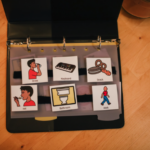
What it looks like: A communication board on the table, a key ring of mini cards for the playground, or a PODD book are some examples.
A speech pathologist can help by: building the book or board, choosing the words, and showing you how to point to the pictures while you talk. This is called aided language stimulation. It is like reading a book to a child before they can read. You model it, and they learn.
An OT can help by: making it easy to use. They might add page tabs, make the book lighter, add a strap, or find the best place to keep it so it is always there.
7. High tech AAC (talking devices and apps)
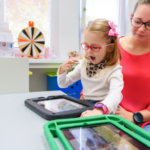 What it looks like: An app on an iPad that speaks out loud, or a dedicated speech device. These can use pictures, symbols, keyboards, different devices have different features and Speech Pathologists help families trial and choose devices.
A speech pathologist can help by: trialling different apps and devices, setting up the words your child needs, and teaching everyone around your child how to use it.
An OT can help by: working out how your child will touch or control the device. This might mean:
- mounting the device on a wheelchair
- a keyguard so fingers don’t slip onto the wrong button
- a switch your child presses with a hand, head or foot
- eye gaze, where your child looks at the screen to choose
- changing the button size and screen position
Who uses AAC?
AAC is for children and adults with complex communication needs. This can come from a condition they were born with, one that develops over time, or an injury.
About 1 in 500 people in Australia have a severe communication disability.
Communication Partners are the people around the child who are part of the plan. Parents, siblings, grandparents, teachers, support workers and friends all learn the communication system. Your child cannot use AAC on their own. It works when everyone joins in.
Who can help?
AAC works best with a team. That team can include:
- a speech pathologist
- an occupational therapist
- a physiotherapist
- a psychologist
- teachers and support workers
- family and friends
- and most importantly, your child
What is the next step?
Keep an eye on our social media this AAC Awareness Month for more tips.
If you have questions, or would like therapy support, contact the clinic:
📞 3265 4495
✉️ info@cooeespeech.com.au