
From meltdowns to connection: Top tips from an Occupational Therapist and a Speech Pathologist at Cooee
“He just explodes out of nowhere.”
“She cries, kicks, then shuts down.”
“We never know what will set him off.”

Sound familiar? For many families, emotional outbursts and meltdowns can feel like daily battles. That’s why emotional regulation is one of the top reasons children are referred to Occupational Therapy (OT).
At Cooee, we team up with families to turn those big, tricky feelings into teachable moments. As OTs, we help kids tune into their body’s early warning signs – tight tummy, racing heart, clenched fists – and build a toolkit of strategies to ride the emotional wave, not get swept away. We also work closely with parents to arm them with the tools to reduce the intensity and frequency of meltdowns, and collaborate with Speech Pathologists (SPs) to explore how language and communication shapes emotional understanding.

Children with emotional regulation needs often have communication difficulties and vice versa (Schmitt et al., 2014). In the absence of adequate language skills to communicate, these children may use behavior as an alternate method to advocate for themselves and their needs. For example, a child may leave the class room, cover their ears, raise their voice to protest or make requests. As a result, such children are often perceived negatively by their peers and others at school or in their social environments.
What these children need are adults in their environment who acknowledge and support their communication and emotional regulation needs. This in turn can help them engage meaningfully in their social and educational settings. Research shows that positive behaviors set a child up for academic and social success in the early years and help reduce future barriers to pursuing a career as adults (Chow et al., 2018).
As health professionals, SPs and OTs work closely and intentionally with families and teachers to help reduce these barriers and perceptions. Key strategies include, firstly, prioritizing emotional regulation, building a positive relationship with the child and following the child’s needs over getting them to comply. This is because, without emotional regulation, a child will not be able to access, use or further develop their language skills to communicate during moments of dysregulation (Greenspan, 2007).
Did you know most children are not expected to self-regulate until around age 7? (Montroy et al., 2016). Neurodivergent children are not expected to consistently self-regulate emotions at the same age or in the same way as neurotypical peers. Many require co-regulation and tailored supports well into adolescence (Wijeratne et al., 2025).
Here are some top tips for supporting emotional regulation you can try at home, from both OT and Speech Pathologist perspectives.
Calm is contagious

Children co-regulate before they can self-regulate. This means they borrow their regulation from their caregivers to find safety and stability. When we slow our breathing, soften our tone, and move gently, we are not just modelling calm – we are offering it.
Try this:
- Find a way to calm your own nervous system. This could be taking a deep breath, grounding yourself, or reminding yourself that this moment will not last forever.
- Try slower movements or a more gentle pace during transitions or moments of distress
- Continue using a calm voice. Say, “Let’s try again” or “I can help” and continue playing the activity without expecting the child to join in. This might ‘tempt’ the child to return.
Name it to tame it

Children are still learning how to recognise and label their emotions. Before they learn how to use their words, children will communicate their feelings through their body and other non-verbals, like crying or screaming. When we help children label their emotions, we let them know that we see and understand them and, overtime, they start to learn these labels too.
Try this:
- Validate the problem and feeling: “You’re feeling really upset/angry that the tower fell. That makes sense”.
- Use emotion cards, drawings or books to explore feelings and emotions
- Let the child ‘sit’ in the emotion by providing him/her time to absorb what you are saying.
- Allow the child space – this may be to let them move away from you, if they choose.
Model your regulation strategies
Children learn best through lived experience, especially from their loved ones. When we visibly use tools and strategies to regulate ourselves, we give permission for children to do the same, as well as a behavior that they can imitate.
Try this:
- Use your own tools in front of your child – e.g., movement break, fidget toys, cold drink, picture boards.
- Use simple, short language and gestures. For example, “I’m upset”–>”I’m going to breathe in (model) and out”
- Use ‘self-talk’ and model the behavior that you want the child to copy. For example, “I’m upset” and “It’s time to go home but I want to keep playing, that’s tricky” and/or “I can breathe in (model this) and out” (model this). “This makes me feel better”
Connection is key – be with your child in the moment
When a child is dysregulated, our instinct might be to fix the problem, distract them, or to retreat from the child. But often, what they need most is presence.
Being with the child – physically and emotionally – helps them feel safe enough to begin calming. This is co-regulation at its core.
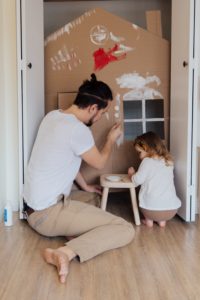
Try this:
- Sit beside or close to your child without demanding eye contact or conversation
- Offer a grounding phrase: “I’m here with you. You’re safe.”
- Match their energy gently, then guide toward calm.
- Give them wait time.
Reduce language when the big feelings hit
When a child is overwhelmed, our instinct is to problem solve and talk through a solution. But did you know that when a child is dysregulated, their ability to use language almost halves? Too many words can feel like noise or feel impossible to process. So instead, use simple phrases, gestures, or visuals.
Try this:
- Use one-step instructions: “Let’s sit down”, “Breathe”
- Use simple phrases: “It’s time for school” “We need to stop” “I am sad” “I need a hug” “I can cuddle with you” “We can come back tomorrow”
- Point to visuals or use hand signals to guide the child
- Remember – All forms of communication matter
Pre-frame transitions and expectations
Children feel safer when they know what’s coming. Pre-framing means giving a heads-up about what to expect next, what’s changing, and what they can do.
Try this:
- Let them know how long: “In five minutes (use a visual clock), we’ll pack up and go outside.”
- Give them options of what they can do: “You can choose a book or drawing after lunch.”
- Offer solutions if they might feel upset: “It’s sad when we have to stop playing. If you feel sad, you can give me a hug, or you can stomp your feet. We get to play again tomorrow.”
Consider the environment
Regulation is often related to sensory processing. Bright lights, loud sounds, scratchy clothes, or crowded spaces can tip a child into fight-or-flight. A sensory-friendly environment supports calm and focus.
Try this:
- Offer quiet zones, noise-cancelling headphones, or movement breaks
- Observe patterns: Does your child typically find noise or busy places tricky?
- Provide visual support of places or toys they child likes.
- Provide language models “I’m tired” “It’s too noisy” “Let’s switch off the light” “I need a break”
I’ve tried these tips. What next?
Regulation is a team effort. OTs bring their knowledge of sensory processing, emotional literacy, regulation strategies and environmental adaptations. Speech Pathologists bring their knowledge of communication, social interaction and emotional expression. You, as the parents and caregivers, bring your unique perspective on what is meaningful and important for your child.
If you’re noticing that your child’s emotional regulation or sensory needs are starting to impact their daily routines, reach out to our Cooee team to book a Client Journey Planning session, where you will meet with one of our OTs to discuss your concerns: (07) 3265 4495 or info@cooeespeech.com.au


This blog post was co-written by Occupational Therapist, Jaime Siu and Speech Pathologist, Sharlet Edwards, November, 2025
Cooee is a multidisciplinary Speech Pathology and Occupational Therapy clinic located in Alderley, Brisbane north.
References
Chow, J. C., Morse, A., & Senter, R. (2022). Intentional Collaboration With Speech-Language Pathologists to Support Language Outcomes of Students With Emotional and Behavioral Disorders. Beyond Behavior, 31(3), 140–150. https://doi.org/10.1177/10742956221108350
Greenspan, S. (2007). Infant-Caregiver Interactions and the Developmental, Individual-Difference, Relationship-Based (DIR) Model: Implications for Psy. Journal of Infant, Child, and Adolescent Psychotherapy, 6(3), 211–244.
Montroy, J. J., Bowles, R. P., Skibbe, L. E., McClelland, M. M., & Morrison, F. J. (2016). The development of self-regulation across early childhood. Developmental Psychology, 52(11),
1744–1762. https://doi.org/10.1037/dev0000159
Schmitt, M. B., Justice, L. M., & O’Connell, A. (2014). Vocabulary Gain Among Children With Language Disorders: Contributions of Children’s Behavior Regulation and Emotionally Supportive Environments. American Journal of Speech-Language Pathology, 23(3), 373–384. https://doi.org/10.1044/2014_AJSLP-12-0148
Wijeratne, K., Pham, S.N., Shroff, D.M., Ollendick, T. H., & Breaux, R. (2025) Self-Regulation in Neurodivergent Children and Adolescents With and Without Co-occurring Anxiety and Depression. Journal of Autism and Developmental Disorders. https://doi.org/10.1007/s10803-025-07029-x