
How do I help my child regulate big emotions?
What Regulation Really Means (and Why Your Child Doesn’t Have to Do It Alone)
 Almost every family we work with talks about emotions in their Occupational Therapy or Speech Pathology at our clinic here in Brisbane sessions at some point. That’s because for kids; just by nature of being kids – they are still learning how to understand, process and work through emotions – and they’re learning first from their parents and carers.
Families often ask if there is an app to teach emotions, or strategies they can use to help children calm down, and social media will recommend the latest sensory tool – but better than that – are some core principles that our therapy team support families to understand and implement.
Every parent or carer experiences these moments: a child is mid-meltdown over something seemingly mundane – a sock, the wrong colour cup, or simply the request to get in the car.
For children who have difficulties with some area of their development, whether it’s speech clarity, fine motor skills, attention, handwriting or other – these daily frustrations with areas of challenge can mean families are doing even more in the co-regulation space.
This month we’re talking about regulation, because learning new skills requires a base of regulation. Big feelings, tricky transitions, it’s all connected, and it’s a lot less mysterious or frustrating once you know what’s going on.
So what is regulation, really?
Regulation is being able to notice what you’re feeling and doing, and manage it well enough to handle whatever is happening around you. For adults, that might look like taking a breath before replying to an email. For kids, the skill is still being built, bit by bit, experience by experience, and a lot of the time they simply don’t have the tools yet.
Emotional regulation is the part most people think of: noticing feelings, staying calm enough to think, and recovering after disappointment or excitement. But regulation also lives in the body.
The way your child takes in noise, touch, movement and light can tip them over before any feeling has even shown up. If you want to know more about that, we wrote about the difference in Sensory Processing and Emotional Regulation: What’s the Difference?
This is also why a big reaction is rarely about being naughty. More often it’s a skill that’s still developing. We unpack that idea in What Emotional Regulation Really Means: Big Feelings, Little Bodies
Part of regulation is also knowing what’s going on inside your body in the first place. Are you tired, or just hungry? Kids (and adults, if we’re honest) who can read those signals early have more time to do something about them. We explain this in Interoception: How Can You Tell If You’re Tired or Just Hungry?
Co-regulation: kids borrow calm from us
Co-regulation is sharing your own regulation with your child, so they can learn to manage their emotions in a safe and appropriate way. Think of it as lending them your calm, or showing them your response/strategy until they’ve built enough of their own.
One way we explain it is with a bucket. Children fill part of the bucket themselves, and the adults around them fill the rest by showing them how to manage their thoughts, feelings and behaviours.
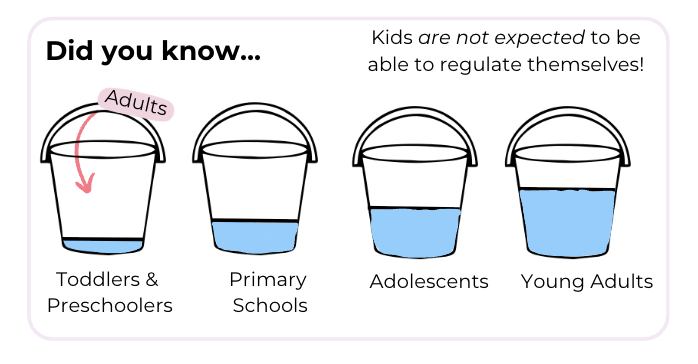
With toddlers and preschoolers, the adult part of that bucket fills most of it. As children move through primary school and into adolescence, their own part gets bigger, but the adult part doesn’t disappear overnight.
Co-regulation tends to rely on three things: a warm and responsive relationship, clear expectations and supports, and a trusted adult who models regulation skills.
In everyday life, that can look like:
-
- Pausing and focusing. Stop what you’re doing, notice what’s happening in your own body, and give your child your full attention.
- Breathing calmly. A slow breath helps your own nervous system settle, and it shows your child what calming looks like.
- Staying nearby. If they’re not ready for help yet, stay close and calm with your body language until they are.
- Naming it. Say what you see in your child (“you’re frowning and stomping, you look frustrated”) and what you feel in your own body (“my heart’s racing, I feel nervous”).
- Giving a template. Show them the way through. “I know buttons are tricky. Let’s do it together.”
- Keeping perspective. Remind yourself that big feelings pass, and that with your guidance, your child can learn to manage them. Some feelings in particular like disappointment, failure, frustration – are really important for children to experience, and learn to manage resourcefully.
- Proprioceptive regulation: Big body movements are known to be the most regulating of the sensory systems. Things like hugging (where appropriate), squeezing, running, jumping, bear crawls – actions where the body is ‘felt’ moving in space are excellent for discharging tension.
For more practical ideas on body-based calm, movement breaks and visual supports, have a look at Regulation and Routines: Occupational Therapy Tools for Everyday Calm
And when your child is upset and you’re not sure what to say, From Meltdowns to Connection has some simple tips from our OT and speech pathology team. Fewer words, calm body, and time usually do more than a long explanation.
How long does co-regulation last?
Co-regulation doesn’t switch off on a particular birthday. It changes. Children lean heavily on trusted adults through the early years and primary school, and their own skills grow steadily alongside that. Children usually become more independent with their emotions somewhere between about 8 and 12, and for some children that takes longer.
So if you’re still doing plenty of co-regulating with an 11-year-old, that’s normal. What shifts is the style – more coaching, with your child taking more of the lead as they get older.
Every family is different
Co-regulation looks different in every home. Your values, your approach to boundaries and rules, and your family’s routines all shape what calm looks like for you. Some families are very structured, and others are much more relaxed. There isn’t one right way to do this. What matters is that you’re a steady, responsive adult within the values and rules your family already has.
Where a child has additional diagnoses, the strategies often need to be more individual. What settles one child can overwhelm another, so this is where professional support and an individual assessment really help. Our OTs and speech pathologists can look at what’s happening for your child specifically and build strategies around that, rather than handing you a generic list.
When what worked stops working
Strategies that worked well can stop working when something shifts. Here are the three big things we see:
- Physical changes. Tiredness, poor sleep, growth spurts, hormones – these all matter, as they’re the starting physiological baseline. Puberty brings big changes to both the body and the emotions.
- Environment changes. New places, a busy party, a relative’s house, a different shop, a new school. Each place brings different demands and different sensory input, and the plan or supports may need to change.
- Routine changes. Anything unexpected or unfamiliar, and changes to the schedule. School holidays, a new term, a new teacher, or a change of classroom can all throw things off. For practical ideas, read How to Help When Routines Change and Holidays Are On
When this happens, see this as information that the plan needs to change, rather than something has gone wrong. Give extra time, lower the demands where you can, bring back the visual supports, and add more movement and breaks. Respond to what the child needs, remember – regulation is the base for all learning, we want to always start with connection.
Look after yourself too
You can’t pour from an empty cup, and you can’t give what you haven’t got. Co-regulation means offering calm, and that’s really hard to do when you’re running on broken sleep, a skipped lunch and a full inbox.
So take the small moments seriously. A breath before you walk back into the room. A few minutes alone, a walk, shower with the door shut, a cup of tea you actually get to drink while it’s hot. Ask a partner, friend or family member to take over for a bit if you can. If you notice you’re running on empty most days, that’s a good time to talk to someone too. Looking after your own regulation isn’t self-indulgent, it’s what keeps co-regulation for your children sustainable.
Want to keep going?
- Access our parent workshop, Big Feelings, Little Bodies, to understand more about regulation and what you can try at home.
- Grab the Big Feelings, Little Bodies eBook, with activities to help children explore interoception and the cues their bodies send them.
- Book a consultative call with one of our OTs to explore strategies you can try at home. You can reach our team at info@cooeespeech.com.au or on (07) 3265 4495.
Written by Speech Pathologist Marion Giddy, November 2026